
Float Level Switch Working Principle Animation

 All float-operated liquid level switches operate on the buoyancy principle: “the buoyant force acting on an object is equal to the mass of liquid displaced by the object”.

As a result, the partially submerged float moves with the level of the liquid in the vessel. Floats are most-commonly used for narrow level differential applications such as high level and low level alarms.
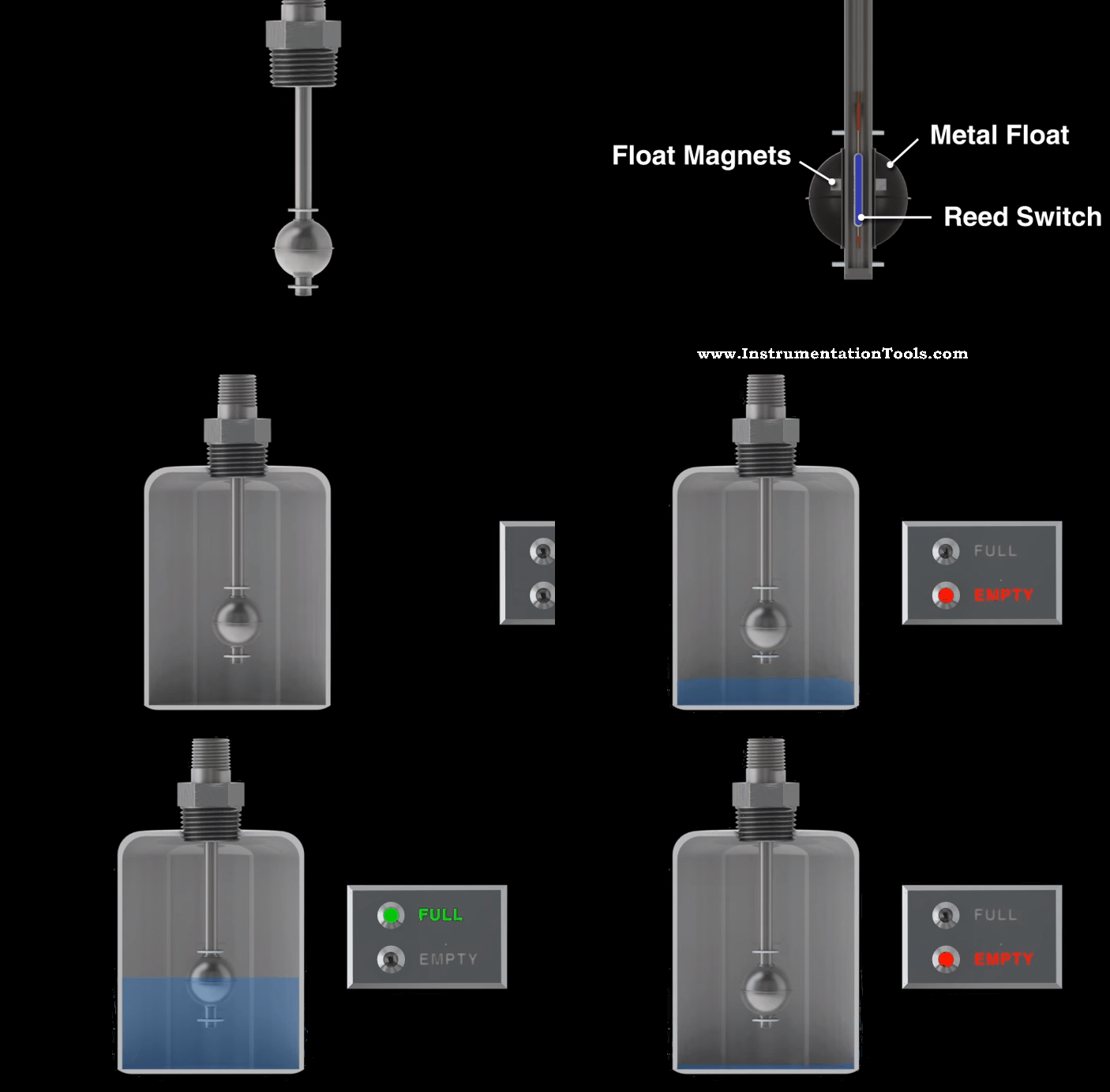


The Float level switches use a float containing an internal magnet and a stem with an encapsulated, hermetically-sealed reed switch.

As the float rises and falls with the liquid level, its internal magnet causes the switch circuit to open and close. The non-magnetic stem isolates it from the process.

Float-type level controls are available for top mounting, side mounting and external chamber applications. Single and multi-level models are used to monitor preset liquid or liquid interface levels.

Optional internal thermostats and RTD’s also monitor process temperature within the same sensor.


Comments

Popular posts from this blog

What is a Torbar? – Averaging Pitot Tubes

 The Torbar is employed for flow measurement of liquids, gases, or steam in circular, square, or rectangular section ducts for large flow rates. The Torbar is an insertion type multi-port self-averaging primary sensor for flow measurement. Torbar TORBAR is a set of Pitot tubes mounted on a bar across the pipeline with no moving parts. An averaging Pitot tube is a technology, while TORBAR is a manufacturing brand name. There are several brands available in the market with VERABAR, ANNUBAR, etc. Averaging Pitot Tube Principle Purpose Averaging Pitot tube can be employed when the average velocity of the flow profile, rather than the velocity in a specific point in the cross-section is desired. Averaging Pitot Tubes Principle It measures the differential pressure between the static pressure tap and the tap of full pressure of a stream. Thus such magnitude of differential pressure is directly proportional to the square of the flow rate. Working The TORBAR is designed in such a way that ...

Ferrules and Cross Ferruling

 Ferrules are identification labels provided for every wire terminations in an instrument, equipment, or electrical/instrumentation control panels. These tube-shaped sleeves can be inserted easily on each individual wire in a multi-core cable. In earlier days fixed digits/letters are used as ferrules, but now Instrumentation engineers/technicians prints out desired ferrules by using a ferrule printing machine. Typical Ferrule The numbers/ letters on the ferrules will be given as per the approved electrical hook up or loop diagrams. This helps technicians to easily identify a particular loop/wiring from a series of terminal blocks and to troubleshoot the desired terminal connection. Separate numbers on the ferrules distinguish the positive and negative polarities of wires, thus ensure the polarity protection of the instrument. Cross Ferruling  As a wire is connected on its both ends, it is quite useful to use a cross reference method for wire identification. Unlike normal ferru...

Thermowell Insertion and Immersion Length

 The thermowell is the industrial housing for temperature elements like RTD or thermocouple or temperature gauges. Thermowell is directly exposed to process fluid/media. Inside the thermowell, element/gauge is installed. Thermowell transfers the heat to the temperature element. Depending upon the element type, the fluid temperature can be known. So Thermowell protects the temperature element against harsh conditions and process fluid. It enables removal of the temperature element for replacement, repair, or testing without affecting the process system. Generally, thermowells are provided with all-temperature Elements like RTD or Thermocouple or temperature gauge. A few exceptions would be bearing RTD, skin type thermocouple, air duct thermometer, etc where thermowell is not applicable / required. When the thermowell assembly is inserted into the pipe, it is subjected to vibration. This vibration is caused by vortices to be generated alternately on either side of the thermowell. The...